

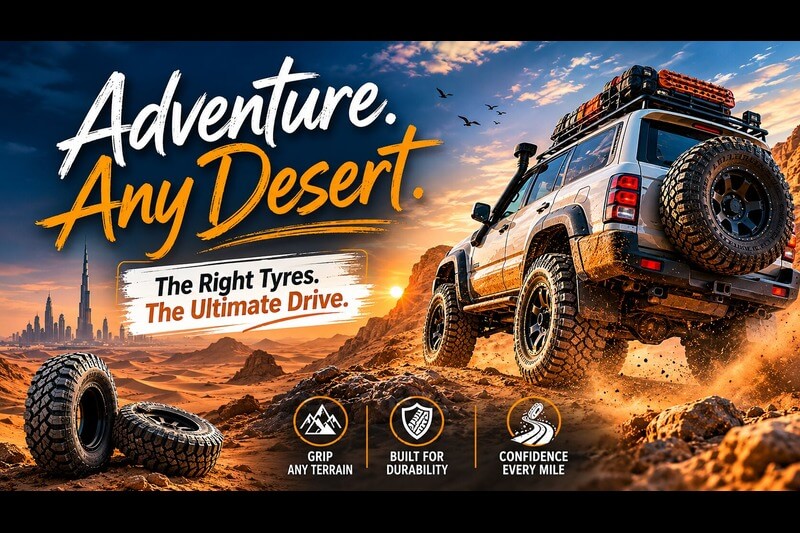
Just after sunrise in Liwa, the sand looks calm. Then the convoy starts climbing.
A Toyota Land Cruiser crests first. A Patrol follows. Then a Wrangler drops pressure and rolls forward into soft dune lines that shift with every gust of wind. Engines work hard. Suspensions flex. But ask anyone leading that drive what matters most at that moment—and the answer rarely starts with horsepower.
It starts with tyres.
In the Middle East, desert driving doesn’t forgive weak preparation. And the right off-road tyre can be the difference between floating over the dunes… or digging yourself out with a shovel before breakfast.
The Middle East isn’t just an SUV market. It’s an off-road culture.
Across the UAE, Saudi Arabia, Oman, and Qatar, off-roading has moved beyond hobby status.
It’s weekend ritual.
Families leave Dubai before dawn for Al Qudra. Convoys cross into Liwa for dune drives. Saudi drivers head toward Empty Quarter routes where sand stretches beyond the horizon. In Oman, mountain tracks and desert transitions demand a different kind of grip entirely.
And the numbers reflect it.
The Middle East tyre market was valued at USD 4.12 billion in 2024 and is projected to reach USD 5.29 billion by 2033, driven largely by growing SUV ownership, aftermarket upgrades, and demand for performance tyres built for regional conditions. This trend is especially visible among buyers researching the best SUVs under 100,000 AED in Dubai, UAE, where durability, off-road capability, and long-distance driving comfort play a major role in purchase decisions.
At the same time, vehicle brands continue leaning deeper into desert capability. New launches like the portal-axle INEOS Grenadier Trialmaster X LETECH and the new GWM TANK 700 show how seriously manufacturers now take Middle Eastern off-road consumers.
But even the most capable 4×4 still depends on one thing touching the terrain.
Tyres.
Why off-road tyres matter more in Middle Eastern deserts than almost anywhere else
Desert driving in the Middle East creates a rare combination of stress.
- Extreme heat.
- Loose sand.
- Sharp rock edges.
- Long highway drives before and after the dunes.
- Sudden pressure changes from air-down to reinflate.
That means tyres here aren’t just about traction.
They’re about adaptability.
The best off-road tyres in the Middle East typically need to do four things at once:
- Float across soft sand without sinking too deep
- Maintain sidewall strength against cuts or punctures
- Handle high ambient temperatures without excessive heat build-up
- Stay stable enough on highways for the drive home
That’s a difficult brief.
Which is why tyre choice becomes personal in the region. Ask five desert drivers in Abu Dhabi and you’ll likely get five different opinions.
But mention BFGoodrich and the conversation usually gets louder.
Why BFGoodrich tyres have become part of the Middle East desert conversation
There are Off-road tyre brands people buy. Then there are tyre brands people recommend around campfires after recovery pulls.
BFGoodrich often sits in the second category.
Especially the BFGoodrich All-Terrain T/A KO2, which remains one of the most referenced tyres among off-road drivers across the UAE and broader Middle East.
Industry guides continue ranking it among the top tyre choices for desert terrain thanks to reinforced sidewalls, sand traction, durability, and strong mixed-use performance between city roads and dunes. That versatility matters.
Because most Middle East drivers aren’t living in the dunes every day.
They’re commuting Sunday to Thursday. Then heading to Liwa, Sweihan, Al Ain desert routes, or Hatta on the weekend. They need a tyre that can handle both.
That crossover, daily usability plus off-road confidence is exactly where many premium all-terrain tyres win.
What makes the “right” off-road tyre for the Middle East?
Here’s the simplest answer:
The right off-road tyre for the Middle East is one that balances desert grip, durability in extreme heat, and dependable on-road performance for everyday driving.
That’s what most drivers are actually shopping for.
Not just aggressive tread blocks, Not just looks, Not the loudest setup in the parking lot, Performance that feels reliable across different terrain, And reliability in the desert feels emotional.
It means:
- Confidence during a dune climb.
- Control during a descent.
- Predictability after deflation.
- Grip when the sand suddenly softens.
- Peace of mind 60 km away from the nearest paved road.
- That’s what tyres really sell here.
- Not rubber.
- Confidence.
The smartest off-road drivers in the Middle East don’t buy tyres for aesthetics anymore
This is where the market is changing.
A few years ago, plenty of drivers chose off-road tyres because they looked aggressive. Today, the buying decision feels more informed.
Drivers compare:
- tread pattern
- tyre weight
- heat performance
- road noise
- sidewall construction
- longevity
- air-down behaviour in sand
Community discussions across UAE off-road groups increasingly reflect this shift less focus on appearance, more focus on use case. Weekend dune bashing? Overlanding? Mixed daily use? Rock sections? Long highway miles?
That maturity says something bigger about the region. The Middle East’s off-road scene is evolving from enthusiasm into expertise.
And the tyre market is evolving with it.
A desert drive always looks dramatic from the outside. The golden dunes. The convoy lines. The rooster tails of sand behind a climbing 4×4.
But inside the cabin, the experience feels much quieter.
- You notice steering feel.
- You notice stability.
- You notice whether the vehicle feels planted… or uncertain.
- That feeling doesn’t come from the dunes.
- It comes from what’s touching them.
In the Middle East, adventure often begins where the asphalt ends. And for many drivers, the difference between a good desert day and a great one starts long before the engine turns over. It starts with the tyres.
